
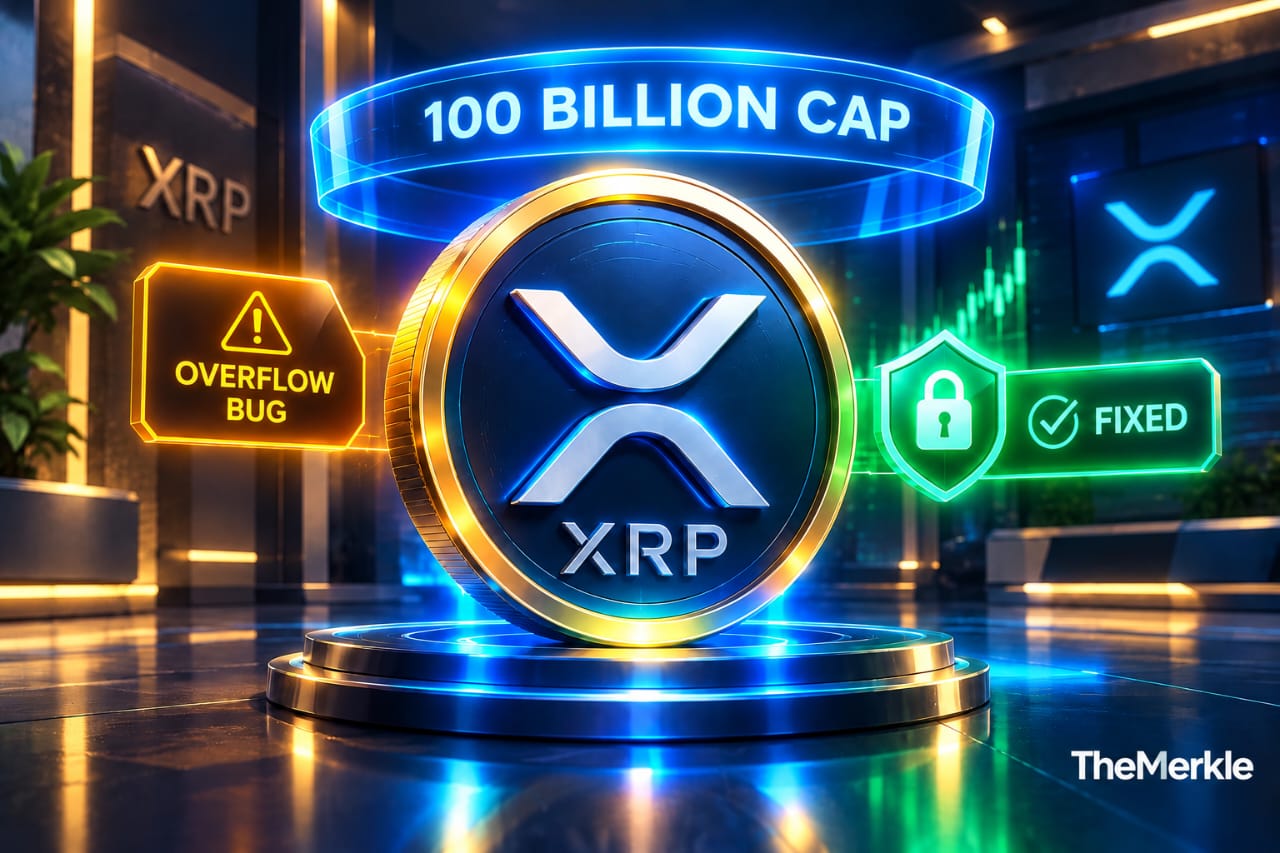
XRP’s supply guarantee has never rested on just a single fact. Instead, it relies on two distinct principles, and a recent disclosure clearly highlighted why understanding the difference matters to the entire crypto ecosystem.
The first principle is straightforward: the XRP Ledger has no function designed to mint new XRP. The second is far subtler: the ledger is engineered so that total supply is strictly conserved, meaning no transaction should ever be capable of creating XRP out of thin air. However, on October 9, the XRP Ledger team disclosed a bug that sat right in the gap between those two ideas. Fortunately, investigators found no evidence it was ever exploited, the overall supply remains fully intact, and the vulnerability has since been sealed.
Examining how this situation unfolded reveals what “hard-coded” truly signifies for a crypto supply cap and why code enforcement is an ongoing engineering commitment rather than a static guarantee.
What the Cap Guarantees and What Protects It
The 100 billion XRP supply was set at the ledger’s creation in 2012, and no function exists within the system to issue more tokens. Furthermore, as Ripple Chief Technology Officer David Schwartz noted in March 2025, no codebase in the XRP Ledger contains logic that permits new XRP creation.
While a missing mint function acts as the primary line of defense, the ledger does not rely on it alone. According to XRPL documentation on invariant checking, the system examines every transaction’s state changes for correctness after execution before anything is committed to the chain. These invariant checks serve as a universal safety net, engineered to catch undiscovered bugs before they can alter core protocol properties. Therefore, the cap is enforced by two distinct operational layers: the total absence of a mint instruction, and a strict conservation rule checked after every single transaction.
What the Disclosure Found
According to the disclosure published on the XRPL blog, the vulnerability resided within the payment engine, specifically in the code that sums up XRP amounts when a single payment consumes multiple order book offers. In this scenario, a 64-bit running total could wrap around once it exceeded its maximum numerical threshold, outputting a significantly smaller number than the true sum.
As a result, a specially crafted transaction could charge a buyer only the wrapped amount while simultaneously paying offer owners their full expected amounts, effectively generating the difference as unintended new XRP. Equally critical, the system’s safety net failed to catch this discrepancy because the post-transaction invariant check relied on similar arithmetic, allowing it to overflow in the exact same manner. Ultimately, the guarantee that supply stays fixed was an implementation detail, and that detail contained a brief structural flaw.
No Exploit Was Observed
Crucially, the most reassuring detail for market participants is that investigators found zero evidence that the flaw was ever triggered on XRPL Mainnet or any other public network. The development team reported no loss of funds, no compromised keypairs, and no consensus errors stemming from the code.
Looking at the timeline, a bounty researcher initially reported the flaw through the XRPL bug bounty program on September 22. RippleX engineers reproduced the issue on a standalone server and dispatched an emergency patch in xrpld 3.4.1 on September 25, just three days later. Public disclosure followed on October 9. Full technical details remain visible via the XRPLF repository release history and the validator-voted updates listed on the known amendments page.
How the Fix Closes the Gap
The software update addresses the issue at both architectural layers. First, the payment logic now explicitly checks arithmetic operations for potential overflow before any totals are accepted. Second, the counter used by the post-transaction conservation check was widened significantly so that it cannot wrap around in tandem.

In addition, a notable process trade-off occurred during deployment. Protocol changes typically proceed through the standard amendment framework, where network validators vote and maintain support over a two-week period. However, this patch shipped as an emergency update because waiting two weeks would have risked exposing the vulnerability while the network remained unprotected. Balancing absolute security against procedural transparency, the team prioritized immediate safety.
What the Episode Says About Supply Guarantees
This incident offers three vital takeaways for evaluating blockchain supply mechanics:
- 1. “No Mint Function” Is Not the Same as “Supply Is Conserved”: The absence of a minting mechanism dictates what commands a network explicitly offers, whereas supply conservation dictates what the software guarantees across every potential execution path. A blockchain can lack an explicit minting command while still remaining vulnerable to implicit token creation via calculation edge cases.
- 2. Invariants Must Avoid Shared Failure Modes: The ledger’s architecture correctly anticipated that software bugs would occur and established an automated check to catch them. Nevertheless, because the safeguard shared mathematical logic with the payment engine, it shared its failure mode. The fix successfully resolves this by isolating the safety check’s mathematical limits from the engine it monitors.
- 3. Rapid Resolution Validates the Security Framework: A decade-old vulnerability was identified by an independent researcher, confirmed, patched, and publicly detailed in roughly two and a half weeks, all without network downtime or asset exposure.
What Holders Should Take Away
In conclusion, the 100 billion XRP supply cap remains intact, and the hole in its enforcement mechanism has been permanently sealed. The honest takeaway is neither that “the cap was a myth” nor that “the cap was never at risk.” Rather, it is a reminder that programmatic supply guarantees rely on accurate underlying arithmetic, and arithmetic requires diligent maintenance.
For token holders, the broader lesson is to treat cryptocurrency supply caps as dynamic engineering assertions that require active, ongoing auditing.
Disclosure: This is not trading or investment advice. Always do your research before buying any cryptocurrency or investing in any services. Follow us on Twitter @themerklehash to stay updated with the latest Crypto, NFT, AI, Cybersecurity, and Metaverse news!