

There’s a reason nearly every major crypto hack ends the same way: stolen funds bouncing across a handful of chains before disappearing into a pool of anonymized ETH.
This week gave us a fresh, real-time example of exactly how that playbook works, as the address tied to the Triple-A exploiter moved millions straight into the crypto industry’s most notorious laundering tool, even after the U.S. government spent years trying to shut it down. I’ve watched this pattern repeat itself enough times now that it barely surprises me anymore, but the speed of it still does.
A Fresh Deposit Reignites An Old Question
Blockchain security firm PeckShield flagged the latest move directly: the exploiter-labeled address tied to the Triple-A hack deposited 2,620 ETH, worth roughly $4.97 million at the time, straight into Tornado Cash.
What caught my attention isn’t just the size of the deposit, it’s the timing. This is happening barely two weeks after the initial breach, and the attacker is still actively moving funds through the mixer in batches rather than dumping everything at once. That pattern alone tells me something about how deliberate this laundering process actually is, it’s not a panic move, it’s a process.
Inside The Triple-A Hack That Started It All
To understand why this deposit matters, you need the full picture of what happened to Triple-A in the first place. Triple-A, a Singapore-based fiat-to-crypto payment gateway, suffered an unauthorized drain of its treasury wallets on July 25, 2026, with losses that started around $9.3 million and climbed to roughly $11.8 million as on-chain investigators tracked additional outflows over the following days. The attacker pulled funds across a genuinely wide spread of chains, hitting wallets on Ethereum, TRON, Polygon, Arbitrum, Solana, and The Open Network before bridging everything back to Ethereum and consolidating the proceeds into a single address holding more than 5,200 ETH.
Triple-A confirmed the breach publicly in its own newsroom statement, and I’d recommend reading their exact wording rather than relying on secondhand summaries: the company said client funds were unaffected since client assets are held separately in trust accounts with independent custodians under Singapore’s Payment Services Regulations, meaning the losses fall on the company’s own reserves rather than user balances. The incident was limited specifically to wallets operated by Triple A Technologies Pte. Ltd., their Singapore entity, and the firm confirmed no other Triple-A entities were affected. Triple-A briefly placed services into maintenance mode for about three hours to secure its infrastructure and has since said it’s working with internal and external cybersecurity experts, blockchain forensics specialists, and the Singapore Police Force to trace the stolen assets.
The Mechanics Of A Tornado Cash Laundering Run
Here’s what I think most people miss about how this actually works. Tornado Cash isn’t a single wallet or exchange you can freeze, it’s a decentralized, non-custodial smart contract system that lets users deposit crypto into a shared pool and later withdraw an equivalent amount from a completely different address, breaking the on-chain trail between sender and receiver. That’s exactly why it appeals equally to privacy-conscious users and to attackers looking to disappear with stolen funds; the tool itself doesn’t discriminate between the two, and I think that neutrality is precisely what makes it so hard to regulate.
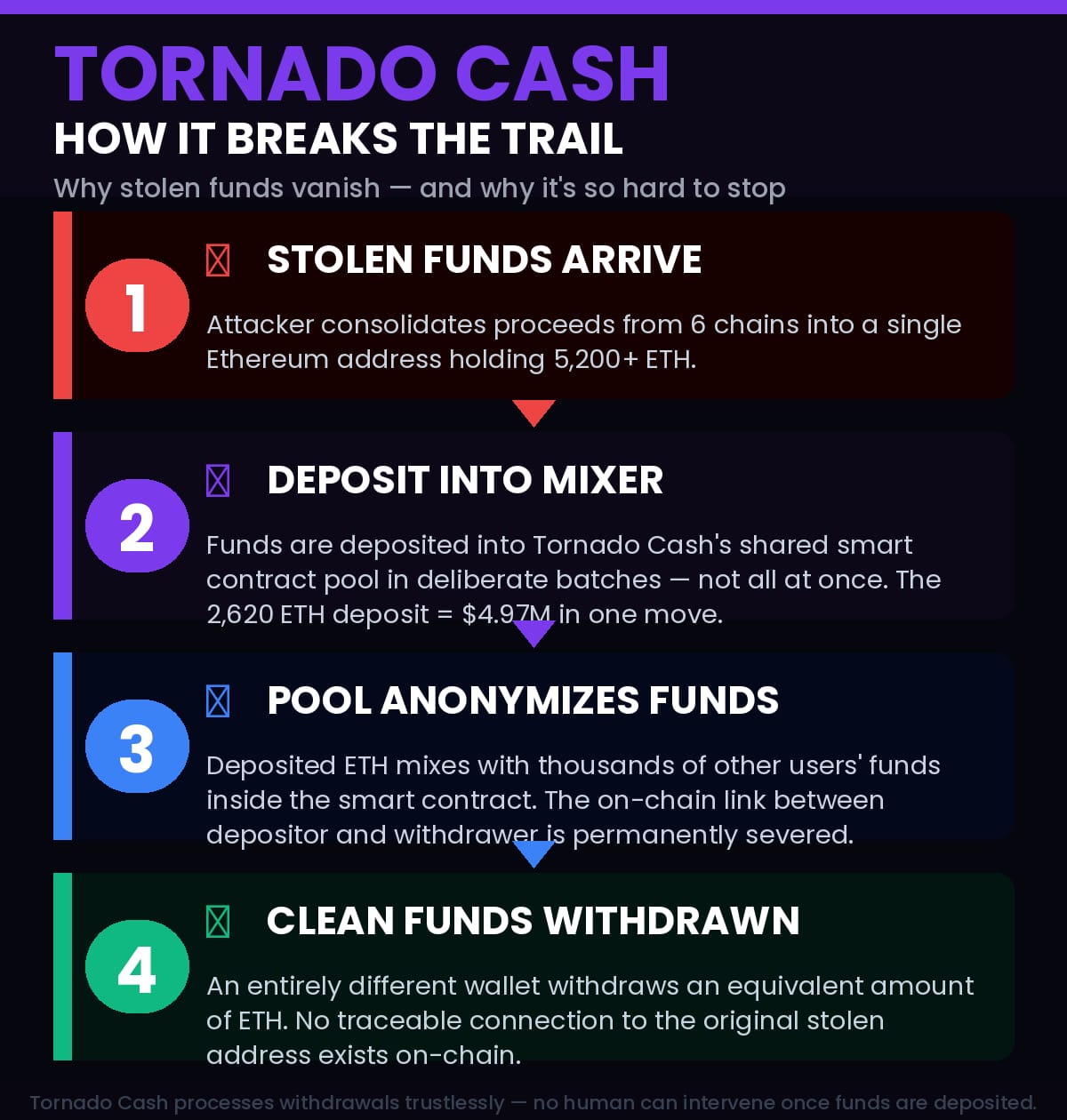
For someone sitting on a freshly stolen $10 million, the appeal is obvious to me. Centralized exchanges can freeze accounts, flag deposits, and cooperate with law enforcement. A decentralized mixer can’t be subpoenaed the same way, and its code keeps running on thousands of nodes regardless of what happens to any single website or developer. That structural difference is exactly why attackers have leaned on it for years, and why the Triple-A exploiter appears to be following the exact same well-worn path rather than inventing anything new.
Why Regulators Struggled To Stop It
Tornado Cash’s relationship with U.S. regulators has been genuinely turbulent, and I think that history explains why it’s still available as a laundering option today. The Treasury’s Office of Foreign Assets Control sanctioned Tornado Cash in August 2022 over its role in laundering more than $455 million stolen from Axie Infinity’s Ronin Bridge by North Korea’s Lazarus Group, along with funds from the Harmony Bridge and Nomad hacks. It was the first time the U.S. government had ever sanctioned a piece of software rather than a company or a person, which I still think is a remarkable regulatory first worth remembering.
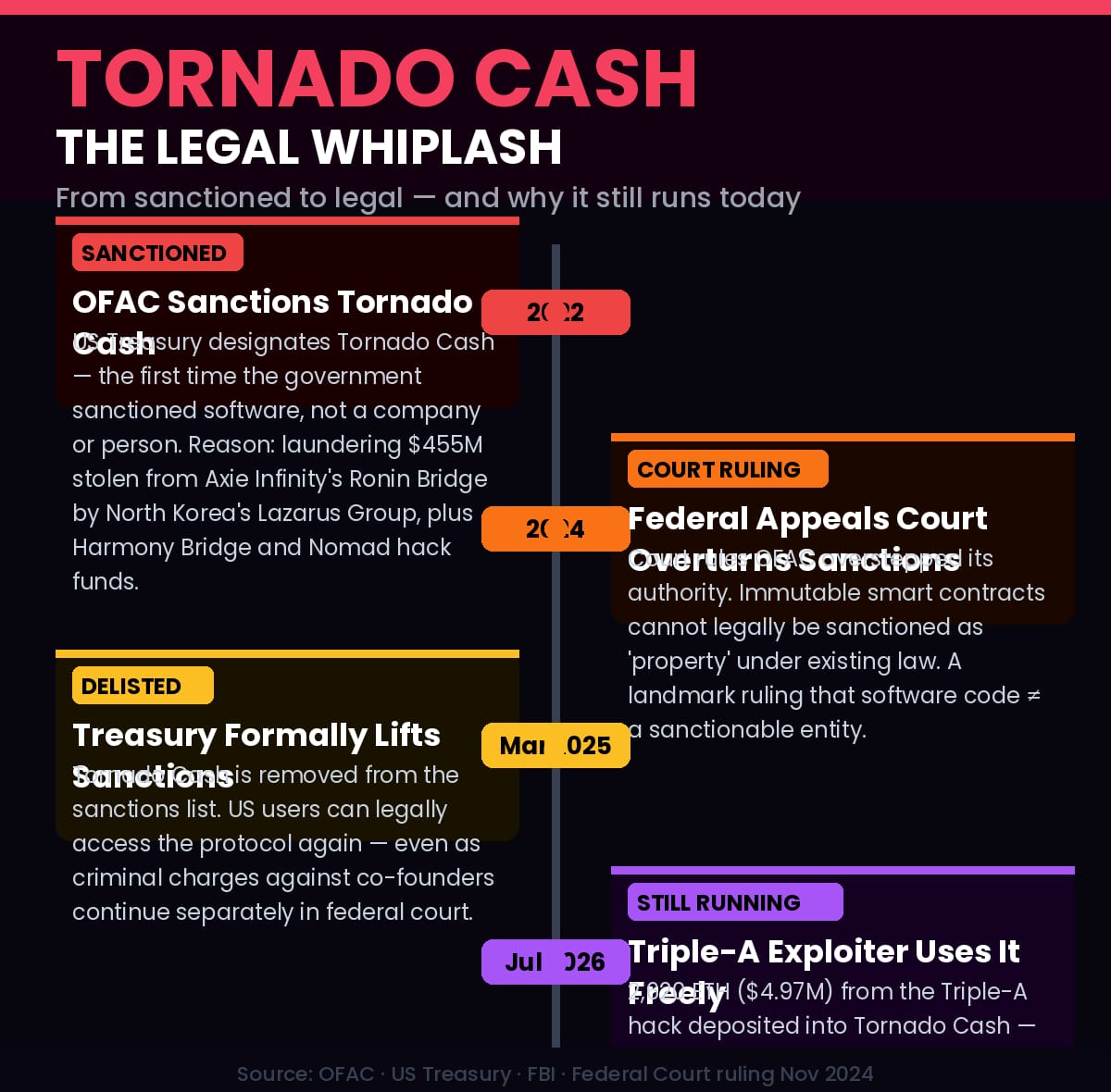
That sanction didn’t hold, though. A federal appeals court ruled in November 2024 that OFAC had overstepped its authority, and the Treasury formally lifted sanctions on Tornado Cash in March 2025, restoring legal access to the protocol for U.S. users even as criminal charges against its co-founders continued separately in federal court. I find that legal whiplash genuinely important context here, it’s a big part of why the tool remains fully operational for anyone, hackers included, wanting to run stolen funds through it in 2026.
Disclosure: This is not trading or investment advice. Always do your research before buying any cryptocurrency or investing in any services.
Follow us on Twitter @themerklehash to stay updated with the latest Crypto, NFT, AI, Cybersecurity, and Metaverse news!