

NordVPN login alerts, password reset warnings, and people swearing they’d just been hacked turned my timeline into a wall of panic within the space of an hour.
The common thread running through nearly every one of those posts was the same three words: NordVPN Dark Web Monitor. I’ll admit, my first reaction scrolling through it was the same one everyone else seemed to be having: had NordVPN itself just gotten breached?
A Wave Of Panic Hits X All At Once
If you were anywhere near X today, you probably saw it too. A sudden flood of users reporting suspicious login attempts, unexpected password reset prompts, and warnings that their accounts may have been compromised, all surfacing within a tight window and all referencing NordVPN by name. I refreshed my feed a handful of times over that first hour and watched the number of posts multiply each time, which is honestly what made me stop and actually dig into what was going on instead of just scrolling past it.
That reaction makes sense to me on the surface. When a security company’s name is attached to thousands of alarming notifications appearing at once, most people, myself included at first, assume the company is the one that got hacked. It’s the same instinct that kicks in during any large-scale breach headline. The problem is that once I started reading NordVPN’s own replies, the story underneath it turned out to be a little more nuanced than a straightforward hack.
What NordVPN Says Actually Happened
NordVPN has been fielding this exact confusion directly on X, and I noticed its response stayed consistent across replies rather than shifting or getting vaguer as the pressure built. In one exchange, the company clarified plainly that its service has not been hacked, explaining that the notification users received was generated by its Dark Web Monitor feature, which detected that a user’s information may have appeared in a third-party data leak available online.
According to NordVPN, the feature works by continuously checking added email addresses and other assets for signs of exposure, such as compromised passwords or other sensitive information, and sending an alert the moment a potential threat is detected.
Reading that reply is what actually settled it for me. NordVPN’s own servers and infrastructure weren’t broken into. Instead, its monitoring tool did exactly what it’s designed to do, scanning the dark web and flagging email addresses that showed up in leaked data somewhere else entirely, and it apparently found a lot of them at once. That distinction matters enormously to me, because it changes who actually needs to react and how, and it’s very different from the panic-inducing version of the story that was spreading fastest.
Where The Five Million Number Comes From
The figure driving today’s alarm is stark: NordVPN says roughly 5 million email addresses turned up as exposed. I understand exactly why that number, on its own, reads like a fresh corporate data breach, especially when it starts flooding people’s timelines as individual, personal-sounding alerts rather than a single company-wide announcement. One user’s post capturing the confusion around the wave of alerts is what first put the scale of this in front of me, and it helped illustrate just how widespread the reaction had already become before NordVPN’s clarifications started catching up.
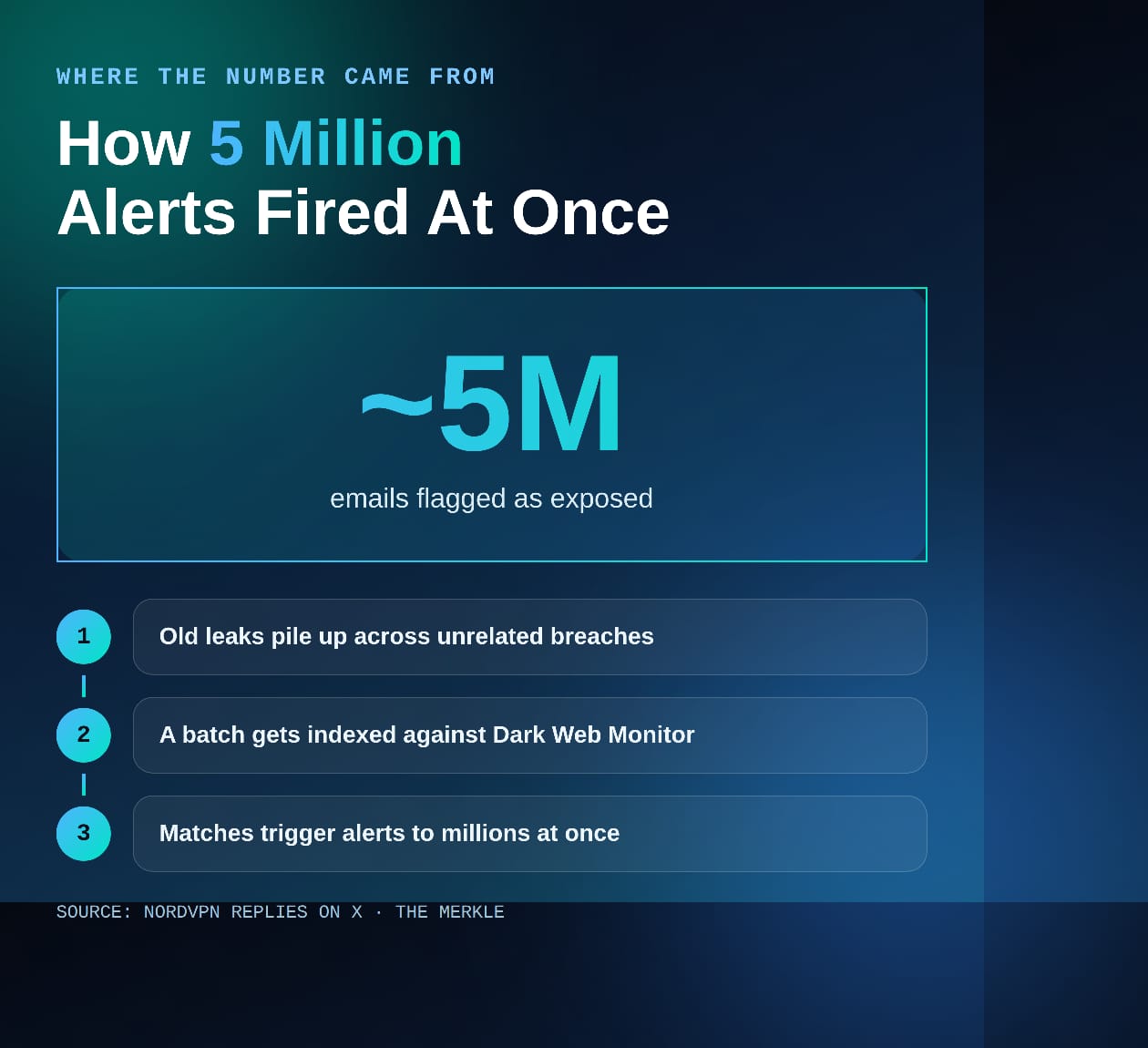
Piecing it together, what likely happened is a batch of previously leaked credentials, compiled from unrelated breaches elsewhere online, got indexed and cross-checked against NordVPN’s Dark Web Monitor database around the same time, triggering a mass wave of alerts that landed on a huge number of users simultaneously. To me, that’s a very different event from a single company being breached, even though the two looked identical from inside my own crowded, fast-moving timeline this morning.
Why This Still Deserves To Be Taken Seriously
I don’t think any of this means the panic was pointless, and I’d push back on anyone brushing the whole thing off now that the “hack” framing has been debunked. Even if NordVPN itself wasn’t compromised, the underlying alert is still worth paying attention to, and I’d treat mine the same way I’m suggesting you treat yours. If your email address genuinely showed up in a third-party leak, that’s real exposure, and it’s exactly the kind of signal that precedes credential-stuffing attacks, where hackers take leaked email-and-password combinations and try them against other services, betting that people reuse passwords across accounts.
That’s almost certainly what’s behind the wave of attempted account takeovers and password reset attempts people are reporting today. Once a leaked email address is confirmed active and paired with an old password, automated tools can rapidly attempt logins across dozens of platforms at once, which lines up neatly with the flood of reset warnings and suspicious login notifications I kept seeing flood timelines throughout the day.
How To Tell A Real Threat From A False Alarm
I get the instinct to panic when you see the words “your account may have been compromised,” because I felt it too before I read further. But the right response depends entirely on what triggered the alert. If you’re seeing a Dark Web Monitor notification specifically, it’s telling you your email showed up somewhere it shouldn’t have, not that your NordVPN account itself was breached. I’d treat it as a prompt to update passwords tied to that email address, particularly on any account still using an old or reused one.
The bigger danger right now, from what I’ve seen today, isn’t the alert itself, it’s the confusion around it. Scammers routinely exploit exactly this kind of moment, sending fake “security alert” messages that mimic legitimate warnings in order to trick people into clicking malicious links or approving login requests they never actually initiated. If a wave of panic like today’s is happening in your feed too, that’s precisely when I’d be most careful.
What To Do To Stay Safe Right Now
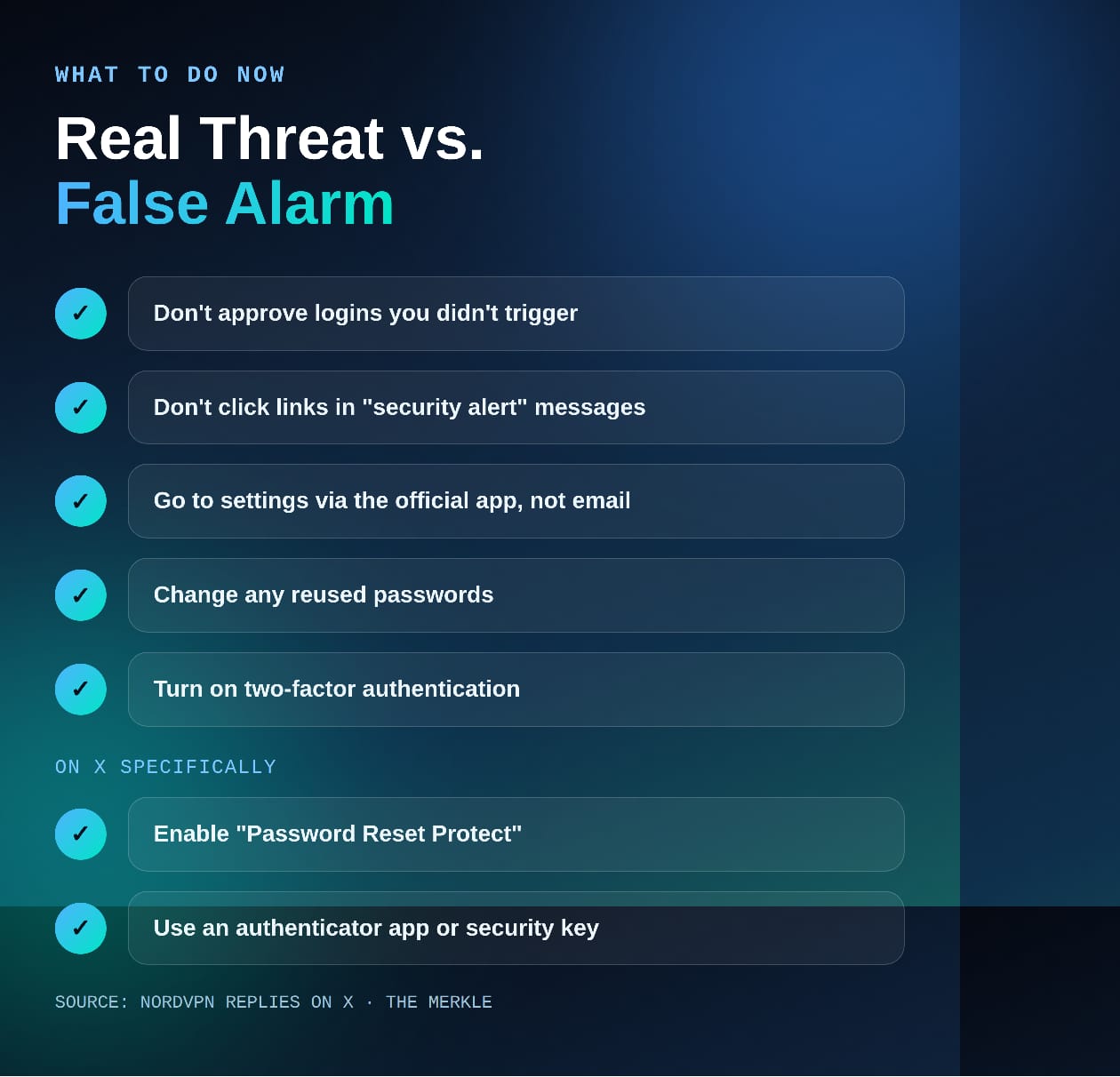
Do not approve any login request you didn’t personally trigger, even if it looks like it’s coming from a service you use every day. Do not click on unfamiliar links inside messages claiming to be security alerts, even ones that reference NordVPN or reuse its branding convincingly. Go directly to your account settings through the official app or website rather than through a link in an email or text, and change any password you’ve reused across multiple accounts. Turning on two-factor authentication wherever it’s available adds another layer that stops a leaked password alone from being enough to get into your account.
If you’re receiving a large number of unsolicited password reset emails on X specifically, make sure you have “Password Reset Protect” enabled. I’d also highly recommend enabling an authenticator app, or even better, using a security key, rather than relying on SMS codes alone.
Today’s wave of alerts, at least from where I was sitting watching it unfold, is a reminder that data leaks rarely stay contained to a single incident. Old, unrelated breaches keep resurfacing years later, and when a monitoring tool as widely used as NordVPN’s finally catches up with them, the result looks a lot like a fresh hack even when it isn’t one.
Disclosure: This is not trading or investment advice. Always do your research before buying any cryptocurrency or investing in any services.
Follow us on Twitter @themerklehash to stay updated with the latest Crypto, NFT, AI, Cybersecurity, and Metaverse news!